


The Truth Travel Contributor
In April of this year my wife (Pamela) and I along with 11 of her relatives travel to Mound Bayou Mississippi in search of their great grandmother’s house and grave site. What we found was a treasure trove of Black History that showed the resilience of slaves during the 1800’s and a little-known Black History fact that reached Toledo.
Somewhere between Emmett Till and Medgar Evers lies the history of Mound Bayou — a story too often overlooked, yet deeply rooted in resilience, independence, and Black excellence.
Mound Bayou, Mississippi, was not just another Delta town. It was a bold vision. Founded in 1887 by formerly enslaved people, it became one of the first all-Black self-governing communities in the United States. At a time when freedom existed more on paper than in reality, Mound Bayou stood as proof that determination could build something powerful in the middle of adversity.
Walking through its quiet streets today, you might miss what once made it extraordinary. But this town was once thriving with Black-owned businesses, banks, schools, and hospitals. It was a place where Black leadership flourished, and economic independence was not just a dream — it was daily life.
A Thriving Black Community
This community became a model of Black self-sufficiency, attracting national attention. Even President Theodore Roosevelt praised it as an example of hope and progress.
Then came the storms of history.
Civil Rights Era Connections
Not far from Mound Bayou, the tragedy of Emmett Till shook the nation in 1955. His brutal murder exposed the violent reality of racism in the Mississippi Delta and became a catalyst for the Civil Rights Movement.
Just a few years later, Medgar Evers, a tireless advocate for equality, would give his life in the fight for justice. Between these two powerful moments lies a community that quietly carried the weight of hope and survival.
Mound Bayou became a refuge during the Civil Rights era. Activists, organizers, and everyday citizens found safety and support there. The town’s hospital treated injured protesters. Its residents opened doors when others closed their doors. While headlines focused on tragedy, Mound Bayou represented endurance.
Yet somehow, its story faded from mainstream memory.
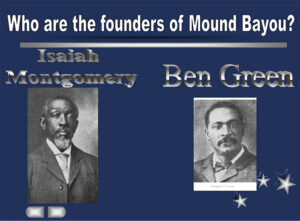 The Founding of Mound Bayou
Mound Bayou was founded in 1887 by two formerly enslaved men, Isaiah Montgomery and his cousin Benjamin Green. They created the town in the Mississippi Delta as a place where Black Americans could live, own land, build businesses, and govern themselves free from the violence and oppression that followed Reconstruction in the South.
The founders purchased land from the Louisville, New Orleans, and Texas Railway along a railroad line in Bolivar County, Mississippi. The town’s name came from two large mounds and a bayou nearby. The railroad company owned large stretches of Delta land and sold parcels to settlers to encourage development along the rail line.
The early settlers had to:
• Clear dense forests
• Drain swampy areas
• Build roads and homes from scratch
• Create farmland suitable for cotton and other crops
The work was extremely hard, but the rich Delta soil eventually became productive for farmland. Over time, the residents transformed the area into a thriving agricultural and business community.
That transformation became part of Mound Bayou’s historical importance — formerly enslaved people built a town out of difficult swamp and timber land and turned it into one of the most successful Black communities in the South.
By the early 1900s, the town became a national symbol of Black self-determination and economic independence. Leaders such as Booker T. Washington praised Mound Bayou as proof that Black communities could thrive despite segregation and racism.
What is Marvin Gaye’s connection to Mound Bayou?
Marvin Gaye was not born in Mound Bayou, did not live there and was not from Mississippi. So, what is his connection to Mound Bayou?
How they are connected
Marvin Gaye’s iconic 1971 anthem “What’s Going On” carries an unexpected connection to Mound Bayou, Mississippi.
• Mound Bayou was a historic all-Black town and a major center of civil rights organizing in Mississippi.
• The issues happening in the Mississippi Delta — poverty, racial injustice, and activism — were the same themes Marvin Gaye addressed in his music.
• His 1971 album What’s Going On spoke about:
social injustice
inequality
war and poverty
the Black experience in America
One of the song’s cowriters, Al Cleveland, was born in Mound Bayou before rising to prominence as a Motown songwriter. Alongside Renaldo “Obie” Benson and Marvin Gaye, Cleveland helped craft a song that became a defining voice of social consciousness in American music. His roots in Mound Bayou link the historic Black community to one of the most influential protest songs ever recorded.

From Mound Bayou to Toledo, Ohio: The Story of Aunt Minnie’s Seebee Restaurant and Aunt Minnie Foods Inc
Born in Mound Bayou, Mississippi, Aunt Minnie grew up in a community built on pride, perseverance, and self reliance. Her kitchen was the heart of her home — a place where neighbors gathered; stories were shared, and Southern flavors told the history of people determined to thrive.
Years later, Aunt Minnie carried those same recipes north to Toledo, Ohio, where she and her daughter Claudia Sebree Pressley opened a small restaurant serving the flavors of home. The restaurant quickly became a local treasure, known for its fried chicken, sweet yams, and soulful service that reminded patrons of the Delta’s spirit. What began as a family kitchen evolved into Aunt Minnie’s Food Inc, a company dedicated to bringing authentic Southern cuisine to tables across America.
Though headquartered in Ohio, Aunt Minnie’s roots remain firmly planted in Mound Bayou—a town built by visionaries who believed in self-reliance and community strength. Her story mirrors that legacy: transforming humble beginnings into a thriving enterprise while preserving the taste and pride of her birthplace. Every dish tells a story of migration, perseverance, and the enduring flavor of Mound Bayou’s heritage.
After closing in the early 2000s, the family’s recipes lived through Aunt Minnie’s Food Inc., preserving the Delta inspired flavors that defined their kitchen. AuntMinnie’s Food Inc ceased operations in 2019.
Mound Bayou Today
Today, Mound Bayou is not just a place — it is a reminder. A reminder that Black self-determination once built thriving institutions from the ground up. A reminder that communities stood strong even when the world around them tried to break them.