
 By Asia Nail
The Truth Reporter
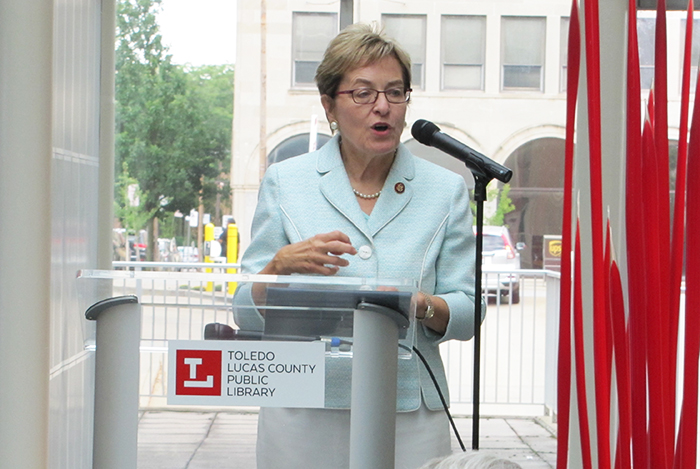
From manufacturing jobs and neighborhood revitalization to rural communities and mental health care, the longest-serving woman in congressional history says her work is far from finished.
For Congresswoman Marcy Kaptur, public service begins at home.
The Toledo native has spent more than four decades in Washington, D.C., while keeping her focus on the community that raised her. From protecting manufacturing jobs to helping rebuild neighborhoods and securing resources for families who need them, Kaptur has built her congressional career around a familiar idea: government should make a difference in people’s everyday lives.
First elected in 1982, the Ohio Democrat represents the 9th Congressional District and holds the record as the longest-serving woman in congressional history. Yet when asked what keeps her going, she doesn’t point to the title. She points to the people.
“I keep fighting for Ohio because I know I’m in a position to make a difference,” Kaptur says to The Sojourner’s Truth during an October 23 interview.
That sense of responsibility has shaped her work through changing political tides, shifting district boundaries and the economic struggles that have tested Northwest Ohio for generations.
Building a Future Without Forgetting Our Roots
Kaptur’s story begins in a working-class Polish-American family in the heart of Toledo, where the value of hard work was woven into everyday life. She graduated from St. Ursula Academy, an all-girls Catholic high school, in 1964. She frequently credits the Franciscan and Ursuline sisters at the Academy with giving her the confidence to lead. Her experience reflects the lasting influence of women mentors and the role they can play in shaping future leaders across Northwest Ohio.
She went on to earn a bachelor’s degree from the University of Wisconsin-Madison and a master’s degree in urban planning from the University of Michigan, later continuing her studies at the Massachusetts Institute of Technology.
Her education helped lay the groundwork for a career focused on communities and the people who call them home. Before entering Congress, Kaptur worked as an urban planner and served as a domestic policy adviser to President Jimmy Carter, helping advance housing and neighborhood revitalization legislation.
When Kaptur entered Congress in 1983, she was one of just 24 women serving in a 535-member House and Senate combined. She went on to build a career in an institution where women remained vastly underrepresented, becoming a trailblazer whose decades of service helped expand the possibilities for women in public life.
Her journey from Toledo to Washington shows what can happen when women pursue leadership without losing sight of their roots.
For Kaptur, a bridge is never just a bridge, and a factory is more than a building. These investments connect people to jobs, families to opportunity and neighborhoods to a future they can believe in. They are part of what keeps a community moving forward.
“In the beginning, there were only two people in office, I think, who believed I could win and actually helped: Congresswoman Shirley Chisholm and Congresswoman Mary Rose Oakar,” Kaptur recalls.
She also remembers the difficult economic conditions she encountered when first elected and the work it took to protect major employers, including the Jeep plant and General Motors facilities.
Kaptur recalls how struggles in major industries affect not only workers, but also their families, small businesses and the surrounding communities.
Today, Kaptur sees potential for more good-paying jobs in northwest Ohio’s steel industry, First Solar’s manufacturing operations and the University of Toledo’s growth. She also points to opportunities in food production, pharmacy and medical innovation, emphasizing how local talent and homegrown ideas can grow into businesses that create jobs and strengthen the region’s future.
Federal Investments, Local Impact
Kaptur’s seniority gives her an influential position on the House Appropriations Committee, where lawmakers help determine how federal dollars are spent. She is the ranking member of the House Appropriations Subcommittee on Energy and Water Development and also works on defense and agriculture spending.
In October, nearly $50 million in federal rail investments were announced for the region on October 16, including a $43.5 million award to improve Toledo’s century-old Swing Bridge over the Maumee River. That bridge helps local businesses get their goods where they need to go, keeping northwest Ohio’s economy moving and families connected to the jobs that sustain them.
Kaptur also discussed investments in Toledo’s Veterans Glass City Skyway, neighborhood health facilities, the Frederick Douglass Center and the Wayman Palmer YMCA. These projects touch different parts of community life, from transportation and recreation to health and neighborhood development.
For her, progress often requires patience.
“The Veterans Glass City Skyway took 16 years to complete,” she explains. Other projects required years of advocacy before funding became available.
Meeting The Needs of a Growing District
The latest congressional map brings additional rural communities into the 9th District, expanding the work required to understand residents whose daily lives may differ from those in Toledo.
Kaptur says she has spent months visiting communities and learning about their needs, particularly those tied to agriculture.
A new farm bill remains a priority, she says, including provisions affecting child and senior nutrition. School breakfast and lunch programs matter in Toledo just as they do in rural communities, where families depend on schools to help children start their days ready to learn.
She is also exploring possibilities for a more affordable passenger rail connecting Chicago, Toledo, Sandusky and Cleveland.
Farmers, factory workers, small-business owners and city residents may face different challenges, but many share concerns about making ends meet, supporting their families and creating opportunities for the next generation.
Across northwest Ohio, every community has its own story, its own needs and its own vision for tomorrow. Kaptur’s opportunity is to continue bringing those voices to Washington, helping to ensure that the people who call this region home have an active part in shaping its future.
Working Together and Caring for One Another
Bipartisanship can feel elusive in a deeply divided political climate. Yet Kaptur’s recent partnership with Republican Congressman Bob Latta on a resolution honoring Fremont’s Rutherford B. Hayes Presidential Library and Museums offers an example of colleagues finding common ground.
Kaptur also recalls that Latta was among the first to call after her recent car accident to check on her well-being.
Their exchange offered a personal example of how colleagues can maintain a working relationship across party lines.
That spirit of service also extends to families navigating mental illness, disability and caregiving. During our conversation, I shared that my mother has spent 49 years working with the Board of Developmental Disabilities and thanked Kaptur for her attention to people with special needs.
Then the Congresswoman spoke about Dani’s Place, a Toledo facility providing longer-term therapeutic care for people living with mental illness, and the need for stronger treatment options in the region.
These issues are not abstract policy debates. They affect parents searching for services, veterans seeking care and families trying to support loved ones without exhausting their own resources.
The People Own the Work
When asked what she wants young women entering public service to understand, Marcy Kaptur offers advice grounded in decades of experience.
Her own journey into Congress began with an idea that many local leaders initially laughed off. In 1982, while challenging a well-funded Republican incumbent, Kaptur needed money for her campaign. Her solution was a bake sale. She and her supporters raised $10,000 selling cookies, pies and pastries, helping fuel an underdog campaign that ended in an upset victory. The fundraiser offered an early example of what supporters could accomplish together.
“Don’t think you can do anything significant by yourself,” Kaptur advises. Real change begins when people who care about the same issues come together, pool their efforts and turn a shared vision into action.
She has seen that collective effort transform neighborhoods and bring long-awaited projects to life. The process can take years, but persistence matters.
As the longest-serving female member in congressional history, Kaptur understands the value of experience. She also understands that holding office is not the same as owning the accomplishments that come with it.
“The seniority I hold belongs to the people that I represent, not to me,” she adds.
That statement captures the responsibility at the heart of her career.
As voters consider the future of Northwest Ohio, important questions remain:
Which issues matter most to our families?
What opportunities should our communities have?
And how will we hold elected officials accountable for delivering results?
After more than four decades in Congress, Marcy Kaptur offers a reminder that public service is not about the title someone holds or the years they spend in office. It is about what those years mean to the people they represent. A repaired bridge, a job that keeps a family afloat, a young person who can build a future without leaving home. These are the things that bring the work in Washington back to the lives of the people it is meant to serve.
No single elected official can build the future of a region alone. It takes neighbors who show up, communities that speak out and people willing to work together even when they disagree. Northwest Ohio’s next chapter will be shaped in Washington, but also right here at home, by the people who choose to take part.
It is something we build together.
Get Informed: To learn more about Marcy Kaptur’s campaign and platform, visit her official campaign website. Ohio voters can visit the Ohio Secretary of State’s elections website for voter information, polling locations, identification requirements and absentee ballot tracking. Staying informed is one way to take an active role in shaping the future of Northwest Ohio.