
 By Asia Nail
The Truth Reporter
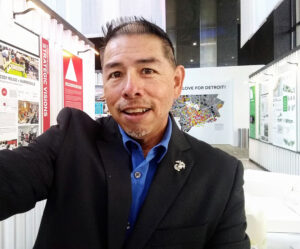
When Roberto Torres talks about Toledo, you can tell it’s personal. His voice softens when he talks about the neighborhoods he grew up around, the ones that were full of family-owned businesses, church socials and kids walking home from after-school programs. “Those places shaped me,” he says. “And the truth is, I think a lot of folks just want to see their neighborhoods come alive again.”
Torres isn’t new to politics or public service. What is different today is how he is choosing to step into leadership. With decades of experience working under six mayors across four cities, he’s now taking the leap to chart his own course as an independent candidate for mayor.
The word “independent” can mean a lot of things. For Torres, it means having the freedom to really listen, to build bridges instead of walls and to care more about people than party lines.
From the Marines to City Hall
Long before city hall meetings and campaign slogans, Torres wore a different kind of uniform. He’s a Desert Storm veteran, a Marine who still carries that quiet discipline in the way he speaks. He says that’s where he learned what honor, loyalty, and keeping your word really mean. “When you serve,” he tells me, “you don’t get to pick and choose when to show up. You make a promise and you keep it.”
He draws a pretty clear line between that sense of duty and the kind of leadership Toledo, in his view, needs now. It’s not just about showing up; it’s about following through. “Too often, people make promises when they’re campaigning and forget them after they get elected,” he says. “That isn’t leadership. That’s convenience.”
There’s a pause before he continues, the kind that may suggest he’s said this before but still feels it. “It’s like we’ve lost the muscle memory for keeping our word,” he says finally. “Somewhere along the way, we forgot what service really means. Thankfully that’s something we can fix.”
 Beyond Party Politics
Torres has been a Democrat most of his life. When he looks at the situation in party politics today, he says, it is barely recognizable. “I believe the democratic way means service to all people,” he asserts. “Now it feels like the system’s forgotten that part.”
He stops before he continues, not out of frustration, but out of honesty. “It is not a question of turning our backs on anyone. It’s about widening the table again. Toledo deserves leadership that invites everybody to sit down, Democrat, Republican, Independent or a first-time voter,” he says.
The balance between firmness and empathy is what makes Torres’ campaign feel different. He doesn’t come across as someone looking to fight the system. He sounds more like someone trying to tune it, so it finally plays in harmony again.
Lessons From Other Cities.
Roberto Torres has the kind of background that tells a real story of the Midwest trying to rebuild itself. He’s lived and worked in places like Canton, Detroit and Grand Rapids, cities that, at one point, were all fighting their way back, just like Toledo is now.
He’s never been afraid to work across party lines if it means getting results. Back in Canton, he teamed up with then-Governor John Kasich, a Republican, to help bring jobs and life back to the city. “We didn’t see eye to eye on everything,” he says with a small smile, “but we both cared about one thing—moving the city forward.”
Over the years, Torres has served under several mayors: Carty Finkbeiner and Jack Ford in Toledo, William Healy in Canton, and Mike Duggan in Detroit. Each, he says, taught him something different about leadership, collaboration and resilience.
Later, in Grand Rapids and Detroit, he worked with Governor Rick Snyder’s team to help Michigan reach beyond its borders and grow its international connections. As Director of the Hispanic Center of West Michigan, Torres focused on international partnerships and cultural attraction, work that caught the attention of the state’s Office of New Americans.
That’s ultimately what led him to Detroit, where he spent six years as Director of the Mayor’s Office of Immigrant Affairs and Economic Inclusion. Those years, he notes, coincided with Detroit’s first real population growth in decades, more than 14,000 new residents, while Toledo, during that same time, lost nearly 10,000.
A City of Corridors and Connections
These experiences have left Torres with a message. He has seen how private businesses, when told to invest in communities instead of skyscrapers, can completely reshape the future of a city.
“Detroit got $300 million in corporate partner funds to rebuild neighborhoods,” he says. “We could do that here too. Toledo has the same heart, we just need a mayor who believes strongly in that form of partnership.”
If elected, according to Torres, the first 100 days of his administration will be spent on what he calls “safe, clean, resilient neighborhoods.” The plan is simple: clean up that which has been neglected.
“There’s no pride in a city if the blocks look like they’ve been forgotten,” he said. “We’ve got to get rid of the slum and blight, fix what’s broken and make our streets feel safe again.”
He would also like to restore community development corporations (CDCs), the heart and blood of communities like LaGrange, Monroe, Dorr and Main streets. “Those used to be our open doors,” he says. “Each had its own heartbeat.”
Housing is another big topic. Torres feels strongly that affordable homes shouldn’t be luxury projects or political handouts, but a must-have for strong communities.”
“We have some great local nonprofits like Habitat for Humanity, NeighborWorks, Friendship Baptist, who know what our families need,” he shares.
A History of Mentorship
Entrepreneurship is a theme that truly lights Torres up. “Toledo was once a city full of small businesses,” he says with a grin. “We can be that again.” Future programs would include getting back to things that help citizens, particularly our youth and minority entrepreneurs, giving birth to their startup operations. “It is just like seed planting,” he explains. “You water them early, and before long, you’ve got a community full of small business owners feeding their own neighborhoods.”
Torres speaks of working with the late Mayor Jack Ford with genuine respect. Together they created a youth entrepreneurship program designed to teach youth the workings of a small business from start to finish. “We had kids that had written business plans, received mini grants and bought their first equipment,” Torres recalls. “Some of them are still business owners today.”
He still runs into many of those former students. “They’ll say, ‘Mr. Torres, you probably don’t remember me, but I was in that program.’ I say, ‘How could I forget?’ That’s the kind of impact that lasts.”
Opening the Door for Everyone
If there’s one word that keeps coming up, it’s inclusion. Torres has a quiet conviction that division can’t survive in a city that works for everyone. “We can’t grow Toledo if half the residents feel left out,” he says. “When opportunity only flows to one side of town, you build resentment instead of community.”
He points to his decades of work with people from every background imaginable: Black, Latino, Asian, African, Muslim, Jewish. “We’ve all faced moments of being left out,” he says. “So we should understand more than anyone that inclusion isn’t charity. It’s smart policy.”
For Torres, it’s not about choosing sides, it’s about building bridges. “Toledo could be a model for how communities grow together,” he says. “A place where diversity isn’t just a talking point, but a strategy.”
Reclaiming Toledo’s Heart
Asked what success would look like years from now, Torres doesn’t hesitate. “I want people to say Toledo became an international city under our leadership,” he shares. “Not because of fancy titles, but because everybody from old South End to Point Place, felt a part of something bigger.”
He adds, “I have seen what happens when cities begin to lose faith in themselves and I have seen the reverse when they start again. I want that second story for us.”
This isn’t the voice of a career politician voicing talking points. It’s more like a neighbor you’ve known for years, someone who’s worked quietly in the background and finally decided it’s time to lead from the front.
And maybe that is the kind of leadership Toledo’s ready for, one built on promises kept, partnerships formed, and the belief that real progress happens one person at a time.
Learn more about Roberto Torres and his vision for Toledo. Election Day is Tuesday, November 4, 2025. Polls open from 6:30 a.m. to 7:30 p.m.