
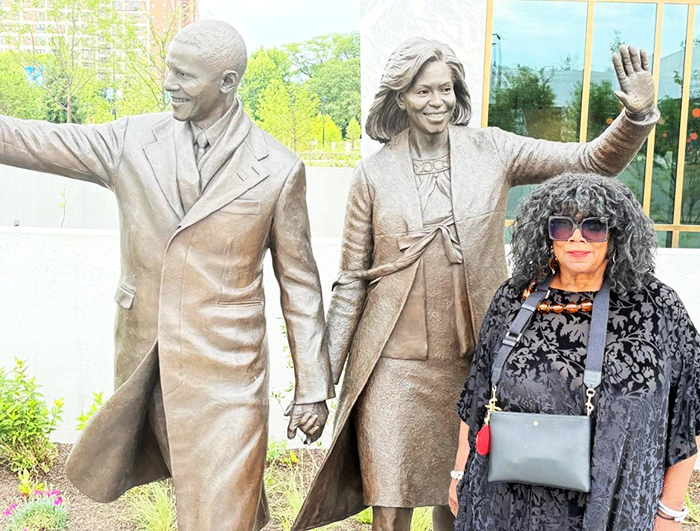
 Based on an interview with world class traveler Ardenia Jones Terry
By Asia Nail
The Truth Reporter
The First Thing You Notice Is the Way the Space Holds You, Ardenia Jones Terry Recalls
You notice your pace before you notice anything else.
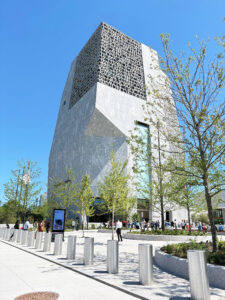
The walk slows, not because you decide to slow down, but because the Obama Presidential Center seems to set the rhythm for how you move through it. Light spreads across the South Side Chicago landscape in long, steady intervals, touching stone, glass and open pathways as if the site is still calibrating how it wants to be experienced.
Nothing at the entrance competes for attention. Instead, the space distributes it.
Just beyond the campus, Chicago asserts itself in quiet context. The South Side carries layers of intellectual, cultural and civic history shaped by surrounding institutions, including the University of Chicago, where Barack Obama taught constitutional law and where Michelle Obama’s early professional life intersected with South Side public service and community-based work. The Center does not separate itself from that ecosystem. It extends it.
The transition is subtle but deliberate: city to campus, academic influence to civic space, observation to participation.
And then the experience begins to shift from visual recognition to something more internal: attention recalibrated.
 Ardenia Jones Terry describes her visit to the Obama Presidential Center as a civic experience shaped as much by engagement and reflection as by architecture and space.
For visitors planning or learning more about the site, the Obama Foundation Official Visitor Guide provides an official overview of the campus, visitor experience and design vision visit www.obama.org.
A Civic Space Designed for Participation, Not Observation
Miss Ardenia describes the Obama Presidential Center as an active civic environment rather than a static monument. During her visit, she observed that the campus design moves visitors through ideas as much as it moves them through physical space.
She emphasizes that the experience requires engagement sharing,
“The Center brings together architecture, storytelling and public design to invite visitors into the American story rather than simply presenting it.”
That distinction defines the structure of the entire campus.
Nothing is positioned for passive viewing. Everything is arranged to prompt a response.
Questions appear in exhibit spaces not as decoration, but as instruction:
What do you think?
Where do you stand?
What does equality require in practice?
For readers exploring the museum experience more deeply, the official museum overview includes highlights such as exhibitions, civic storytelling spaces, the Sky Room and the conceptual Oval Office experience.
 Arrival at John Lewis Plaza
Miss Jones Terry remembers her first moments on campus.
As her rideshare pulled away and she stepped into John Lewis Plaza, she paused.
“I was in awe,” she recalled. “It was almost like walking in the air. I was filled with joy and bursting with pride.”
In that moment, the Center stopped feeling like a destination and became an experience. Before she entered a single gallery, the campus had already begun telling its story.
Planning the Visit
The Obama Presidential Center is designed as both a civic campus and a museum experience.
Visitors can move freely through outdoor spaces including plazas, gardens, walking paths, and gathering areas. The museum itself includes multiple levels of exhibitions focused on democracy, civic engagement, and American history.
Some portions of the museum experience require timed entry, while the campus itself remains an open civic space designed for public engagement. The design allows visitors to engage with architecture, art, and landscape even before entering the core museum experience.
 Where American History Becomes Immediate
Inside the Center, American history is not presented as a completed narrative. It is staged as an ongoing exchange.
Ardenia Jones Terry’s reflections reinforce that framing. “The experience moves beyond information into interpretation, and exhibits require visitors to examine their own assumptions about freedom, equity, and civic responsibility,” she recalls fondly.
The design choices shift the role of the museum entirely. They don’t ask visitors to absorb history. Instead, it asks them to respond to it.
The experience is structured around engagement rather than consumption. Exhibits interrupt rather than conclude and fascinating information leads to reflection rather than closure.
For a more immersive layer of this experience, the Obama Foundation’s official digital museum guide (Bloomberg Connects) offers audio narration and storytelling from President Obama, Michelle Obama, Oprah Winfrey, Tom Hanks and others.
In practice, this creates a continuous loop: history presented, interpretation required, meaning deferred.
Art, Scale and the Architecture of Memory
Art within the Center functions as infrastructure for meaning rather than ornament.
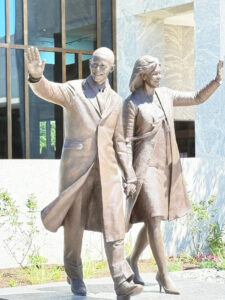
Large-scale installations, civic imagery, and portraiture shape how visitors interpret space. One installation, described by Jones Terry, establishes the emotional tone immediately upon arrival.
The Obama Foundation’s official “Art on Campus & Stories” collection documents the artists, installations, and design intent. These pieces do not illustrate history. They organize it.
They guide attention, shape emotion, and structure memory across space.
When the Space Begins to Ask Questions Back
At key moments, the Center shifts from presentation to interaction.
Exhibits introduce prompts that interrupt the visitor’s passive engagement and require interpretation:
Some Americans question whether freedom is granted equally.
What do you think?
Jones Terry describes these moments as intentional disruptions in the flow of observation: “The visitor is no longer outside the narrative. They are placed inside its unresolved tensions.”
The Center does not resolve those tensions either, it exposes them.
And in doing so, it redefines what a museum experience can be.
Hope as Structure, Not Symbol
Throughout the campus, hope functions as a structural principle rather than a thematic message.
It is embedded in how visitors move through the space.
Ardenia emphasizes, “The Center asks visitors what they will do to contribute to making the country better.”
In this framing, hope is not emotional sentiment. It is an operational responsibility.
It requires action even in the absence of certainty.
Legacy as a Shared Construction
For Ardenia, the experience also prompts reflection beyond the Center itself.
She connects what she witnessed to broader questions of civic life, leadership, and representation, particularly the ongoing need for dialogue around women’s leadership and institutional continuity.
“Black women are among the most highly educated demographic groups in the United States, yet are still not always reflected in leadership pipelines once they leave office or institutional roles,” shares Jones Terry.
Her perspective reframes legacy not as ownership of memory, but as responsibility carried forward.
What is built here, she suggests, does not end at the gates.
It continues through the people who move through it.
Travel as a Classroom
Miss Jones Terry’s appreciation for the Obama Presidential Center did not begin with a single visit. It has been shaped by decades of travel, teaching and lifelong learning.
Having visited more than 160 countries and destinations, she believes travel does more than introduce people to new places, it challenges assumptions, deepens empathy, and brings history into sharper focus. “You definitely do not return home the same,” she reflects. “It changes your perspective. You begin to see what’s important and what isn’t.”
For those hoping to embark on extended travel, Jones Terry encourages planning well in advance. Long journeys often require passports, visas, vaccinations and careful preparation at home, but she believes the rewards far outweigh the effort. Her advice is simple: don’t wait for retirement to see the world. Many of history’s greatest lessons, she says, are best understood by standing where they happened and meeting the people who continue to shape them.
Leaving Without Closure
The experience of the Obama Presidential Center does not conclude in a traditional sense. It continues after departure, shaped by unresolved questions and layered impressions.
Ardenia’s reflections reinforce that outcome. She describes a space that does not deliver final answers but instead leaves visitors with sustained inquiry about history, participation, and responsibility.
What begins as a slow walk becomes something more enduring, an adjustment not only of pace, but of perspective.
The Center does not close meaning. It carries forward the philosophy Barack and Michelle Obama placed into its design: that democracy is not something displayed, but something practiced.
And even after the campus fades behind them, visitors are still moving within the presented ideas—still inside the questions it asked them to carry home.
Explore official resources from the Obama Foundation for deeper context on the Center’s mission, exhibits, and visitor experience:
Obama Foundation