
 By Asia Nail
The Truth Reporter
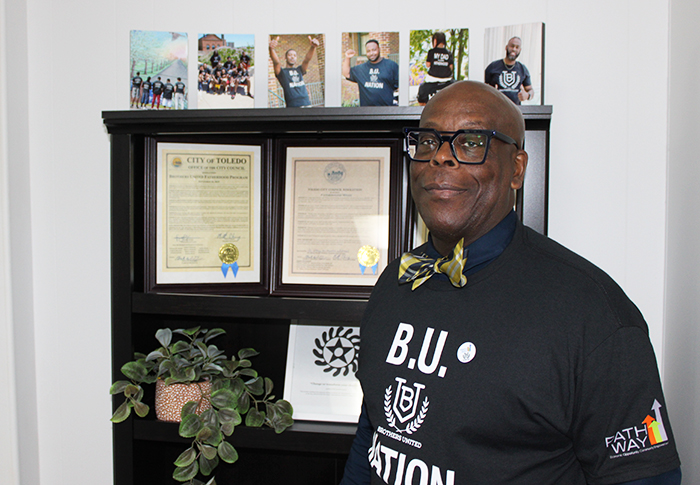
For Micheal Alexander Sr., fatherhood is bigger than a last name.
It is showing up. It is being a steady voice when a young person needs direction. It is having enough life experience to say, “I’ve been there,” and enough humility to help somebody else avoid the same potholes.
Now, Alexander is bringing that philosophy to the helm of Brothers United, the Pathway Inc. program that has spent the past decade supporting fathers and strengthening families in Toledo.
He is not walking into an empty room.
Avis Files built the foundation for Brothers United in 2015, developing a program rooted in fatherhood, family and the real needs of the community. Alexander says Files has already become a friend and resource as he steps into the next chapter.
“She’s left a phenomenal framework,” he says.
His goal is not to tear down what has been built.
It is to keep building higher.
A New Chapter, Not a New Foundation
Alexander has been in his position for nearly four months, and he already sees room for Pathway Brothers United to stretch its reach.
The current FORGE fatherhood grant began in 2025 and is entering its second year of its five-year funding cycle. Because the program is not income-based, Alexander sees an opportunity to reach fathers across a much wider spectrum.
That includes fathers, grandfathers, uncles and foster fathers who have a child in their lives age 24 or younger.
“We have a lot of room for outreach,” he explains.
That matters because fatherhood does not come in one package.
There is the dad working two jobs and trying to make it home before bedtime. The father rebuilding after a divorce. The grandfather raising grandchildren. The stepfather who chose to love a child who does not share his DNA. The uncle who became the dependable man in the room. The young father who is still figuring out what being a father actually means.
And sometimes, a man can be providing for everybody else while quietly needing somebody to pour back into him.
Brothers United wants to be that place.
The Only “Hood” They Claim
The organization’s familiar message says it plainly:
The hood we claim is fatherhood.
For Alexander, that means fatherhood is not simply biological.
“It’s being the support system,” he says.
It means stepping into spaces where young people need guidance and being intentional about the impact a man leaves behind.
That last part is important.
A father does not have to be perfect to be present.
He just has to understand that somebody is watching.
A son may watch how his father handles pressure. A daughter may learn something about love from how her father treats people. A teenager may remember the uncle who answered the phone when nobody else did.
Sometimes fatherhood looks like a paycheck.
Sometimes it looks like a ride to school.
Sometimes it is a conversation in the driveway that lasts 10 minutes longer than expected.
Sometimes it is simply being there.
Alexander says the goal is to “leave fathers better than when they arrived.”
That is a philosophy that reaches beyond parenting.
When Men Have a Place to Grow
Alexander is candid about some of the barriers fathers face.
Some are personal choices. Others are generational.
When a man grows up without a strong father figure or stable household, he may enter adulthood without having seen certain lessons modeled. Then those gaps can repeat themselves in the next generation.
Alexander says Pathway Brothers United works to help men break through those barriers by connecting them with education, GED opportunities, employment and other resources.
But there is another piece that can be harder to talk about.
Men need men.
Not men standing around judging each other.
Men sitting at the same table, sharing what they have learned.
The Pathway Brothers United four-week program gives fathers that kind of sounding board. Even a man who already has a good job can benefit from the fatherhood development, relationship and co-parenting tools offered through the program.
Alexander also wants fathers who have completed the training and found employment to return and encourage the men coming behind them.
That creates something bigger than a class.
It creates a brotherhood.
A Bigger Table
Perhaps one of the most significant parts of Alexander’s vision is his desire to make Pathway Brothers United feel increasingly multicultural and inclusive.
He wants fathers from different income levels and nationalities to see themselves in the program.
That is more than a numbers game.
It is an opportunity for men who might never otherwise sit together to discover that they have more in common than they thought.
Race can shape a person’s experiences. So can poverty, wealth, geography, religion and family history. Those differences are real.
But when communities become completely isolated from one another, assumptions can grow in the empty spaces.
One group hears stories about another group without ever meeting the people behind them. Bias can become comfortable. Fear can grow where familiarity is missing.
Bringing people together does not erase differences.
It gives people a chance to understand them.
A father from one neighborhood may discover that the father across town worries about the same things: keeping his children safe, paying the bills, being respected and leaving something better behind.
Different backgrounds.
Same concerns.
Same children growing up in the same city.
Alexander wants Pathway Brothers United to help create those connections.
He also hopes to strengthen relationships with faith communities and men’s ministries, while bringing established men into the program to share their experiences with participants.
Because sometimes a man does not need another lecture.
He needs to see somebody who made it.
Providing More Than a Paycheck
Alexander understands the dignity that comes from being able to provide.
He describes employment and financial stability as empowering for fathers.
A decent job can change how a man sees himself. It can give him the ability to buy what his children need, plan beyond Friday and stand a little taller because he knows he is contributing to his family’s well-being.
But Pathway Brothers United is not simply a workforce program.
If a father already has a good job, he can still benefit.
If he needs a college degree, there are resources.
If he needs help navigating child support, there are resources.
If he needs another organization, Pathway Brothers United can make the connection.
If he needs to talk about something he has never felt comfortable saying out loud, Alexander says there are people who can help him find the next step.
That is what makes the work human.
You don’t have to arrive with everything figured out.
You just have to be willing to start.
For the Father Who Is Still Trying
Alexander has already seen fathers come through the program, graduate, earn certificates and secure jobs.
His message to a struggling father is simple:
Reach out.
Talk to somebody.
Find out what help is available.
Then do your part.
“We’re putting in the work and the effort as well,” he says.
There is no promise that fatherhood will be easy.
There is no perfect manual.
But there is power in a man deciding that whatever happened before today does not have to write the rest of his story.
Alexander is taking the wheel at Brothers United with a foundation behind him, a broader table in mind and a simple belief at the center of it all:
Men can grow.
Fathers can become more intentional.
And when fathers have the support to become stronger, the impact does not stop with them.
It reaches their children.
Then their families.
Then the community.
That may be the real work of Pathway Brothers United’s next chapter: reminding men that fatherhood is not about having all the answers.
It is about being willing to show up, learn, grow and leave something better behind.
Interested in Brothers United? Fathers and father figures can learn more about the program, available resources and ways to get connected through Brothers United at Pathway Inc.