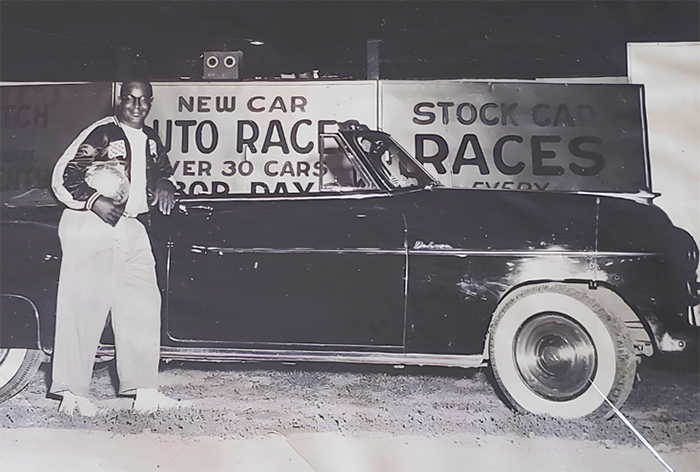
I was invited to my first family reunion on my father’s side. My father, Willie T. Tyus, died in October 1961, and all his immediate family had died by the time I was sixteen. I wanted to bring a picture of my dad, but I only had two. One showed him standing in front of a race car, and the other showed him standing next to a woman I didn’t know. So, I used a picture of my father standing next to the race car. The woman standing next to him was his sister, who died the day before my father. A double funeral was held in Dyersburg, TN, at my grandmother’s house. I was only 7 years old, but I remember it well.
The picture of my dad standing next to the race car is where the story begins. First, let me explain: my dad, Willie T. Tyus, is not the same Willie T. Tyus who was the father of Wyomia Tyus, who became the first athlete—man or woman—in Olympic history to win gold medals in consecutive 100-meter events, a feat that took two decades to overcome. The second woman to do so was Gail Devers at the 1992 Barcelona Games.
In the 1950s, Toledo was a city where automobiles were more than a way to get from one place to another. Cars were part of the city’s identity. They carried people to work, families to church, and, on weekends, racing fans to the dirt tracks where stock cars thundered around the oval.
One of those places was Raceway Park on North Detroit Avenue.
For the men who built and raced the cars, racing was rarely a glamorous business. It was a world of garages, tools, engines, welding, fabrication, late nights, and long hours. A driver’s success depended not only on what happened behind the steering wheel, but on the people who prepared the automobile before it ever reached the track.
Among those people was my father, Willie T. Tyus.
My father was a Black man working in Toledo during an era when opportunities for African Americans were often limited and when the history of automobile racing was usually written around drivers’ and car owners’ names. Mechanics, fabricators, and members of the racing crew could easily disappear from the record.
My father did not drive the story from the driver’s seat. He helped make racing possible.
Toledo’s Racing Scene
The newspaper pages from 1954 show just how active Toledo’s racing community was. Raceway Park, located at 5555 North Detroit Avenue, advertised stock-car races, special events and large racing programs. One advertisement promoted a night of stock-car racing along with a daredevil show and announced that more than 30 cars were expected.
Another 1954 advertisement promoted stock-car racing at Raceway Park with qualifying and racing scheduled for the evening.
These were not small backyard contests. Stock-car racing has become a genuine spectator sport.
And behind those cars were men who knew how to make an automobile survive the punishment of a race.
Willie T. Tyus and the Bauman Connection
My father’s connection to the racing world is especially important because of his association with the Bauman racing operation and driver Roy Bauman.
In the 1950s, a competitive race car was a team effort. The driver might receive attention when the checkered flag fell, but the people in the garage were responsible for giving him a car capable of getting there.
My father’s work placed him close to that competition.
That connection matters because it puts an African American mechanic and racing worker inside the story of a competitive Toledo-area racing operation—not as a spectator standing outside the sport, but as someone who helped build and maintain the machinery that went onto the track.
The race car was only what the public saw.
The real work began long before the green flag dropped.
The Photograph
One of the most powerful pieces of evidence is a photograph of my father (Willie T. Tyus) standing beside a race car at Raceway Park.
He is holding a racing helmet, standing beside a stock-type automobile while racing signs are visible around him. The signs advertise “AUTO RACES” and “STOCK CAR RACES,” with one announcing “OVER 30 CARS.”
The photograph does something newspaper results often cannot.
It puts a face to history. It shows my father in a racing environment.
It shows that he was there. It gives us a glimpse into a world where Black men like my father could contribute their mechanical skills to a sport that was becoming increasingly popular in postwar America.
More Than a Race
When we look at old racing results, it is easy to remember only the winner. The driver gets his name in the paper. The car numbers are recorded.
The owner may receive recognition. But racing has always been a team sport. Someone had to build the engine. Someone had to prepare the chassis. Someone had to repair the car after a wreck.
Someone had to make sure the automobile was ready when it was time to return to the track. Someone had to stay in the garage when the crowd went home. Those people were part of the race, too.
My father, Willie T. Tyus, was one of them.
A Black History That Deserves to Be Remembered
The story of Black history in Toledo is often told through churches, factories, neighborhoods, civil rights organizations, and prominent community leaders. But history also lives in places we don’t always think about. It lives in garages. It lives beside racetracks. It lives underneath the hood of an automobile. It lives in photographs that survived when the names of the people in them were almost forgotten.
My father’s story lets us view Toledo’s 1950s racing culture from a different perspective. He was not simply a man who happened to be standing beside a race car. He was part of a racing community.
He belonged to a working-class mechanical culture.
And, through his connection to the Bauman racing operation and Toledo’s stock-car scene, he became part of the history of automobile racing in the city.
Remembering My Father Willie T. Tyus
Today, the roar of those 1950s stock cars has faded. Raceways change. Cars disappear. Tracks are repurposed or forgotten.
New generations may never know the names of the men who spent their nights preparing those machines. But the photographs remain.
Newspaper advertisements remain. Race results remain. And family memories remain. Together, they allow us to reconstruct a story that deserves to be told.
My father, Willie T. Tyus, was there.
He was there when stock cars filled Toledo’s racing tracks. He was there when men turned ordinary automobiles into racing machines.
He was there in the garages and around the cars. And he was there at a time when simply being a Black man working within the world of organized automobile racing was itself a part of a larger American story.
This is the story of my father, Willie T. Tyus.
This is the story behind cars. And this is a piece of Toledo’s Black racing history that should not be forgotten.