
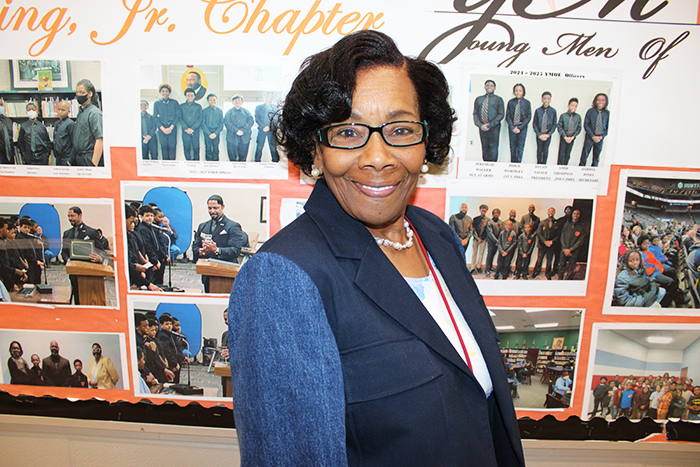

By Asia Nail
The Truth Reporter
A school may be closing, but a legacy of love, discipline and “never giving up on young men” refuses to leave quietly.
There are goodbyes that feel like a door closing.
And then there are goodbyes that feel like a whole building exhaling at once.
For Sheila Cook, Martin Luther King Jr. Academy for Boys was never just a job. It was a living, breathing assignment. A place where ties were straightened, futures were challenged, and boys were reminded daily that they were more than what the world sometimes labeled them.
Now, the building is closing. The halls that once carried laughter, frustration, progress, and second chances are preparing to fall quiet in a different way.
And Cook? She is still trying to process what quiet even means.
 “We went international…and I said, is this real?”
When she talks about MLK Academy, her memory doesn’t start small.
It starts global.
“One moment that really defines it,” Cook says, “is when we went international. People were calling, sending messages from France, Germany, Africa… and I said, ‘Is this real?’”
It was real.
What started as a local boys’ program turned into something bigger than anyone planned. Families across the world were watching what these young men were becoming.
And Cook just kept building.
“If Mr. Ward said go for it, I went for it,” she says, referring to principal Willie Ward. “That’s how we did things. We made it happen.”
 Not just programs. A whole system of belief.
Cook’s title reads long on paper: family liaison, outreach coordinator, professional services, but she explains it simply:
“I was the bridge,” she says. “Between families, teachers and everything in between.”
That “in between” is where most of the real work lived.
She connected parents to resources, calmed misunderstandings, translated school language into something families could actually use. She also created programs that didn’t exist before she got there.
Young Men of Excellence. Mentoring pipelines. Dress-code pride. Etiquette training. After-school structure that felt more like guidance than punishment.
And then there were the events, the ones people still talk about.
Mother-son dances where she cooked half the food herself.
Father-son nights where men showed up in numbers so large she had to stand at the back just to take pictures.
“We weren’t just doing events,” she says. “We were building memories they could hold onto when life got hard.”
 The boy who changed everything
When asked about one student who represents her work, her voice slows.
There was a young man with anger issues. A boy she worked with for two years straight.
“He would clench his fists,” she remembers. “And I would say, ‘Bring it down. Breathe.’”
She didn’t give up on him, even when it was exhausting, even when it got tense.
“I said, that is not who you are anymore,” she recalls telling him. “What do you do? You breathe.”
That moment became a pattern. A language. A tool.
“And when I say he transformed,” she adds, “he really did.”
For Cook, these stories are not rare. They are the job.
“I don’t give up on them,” she says simply. “These men are the world’s future husbands and fathers.”
 A school that became a family system
Cook didn’t separate school from life. She couldn’t.
She raised her own children while helping raise hundreds of others. That connection made families trust her more than titles ever could.
“I’ve been where they’ve been,” she says. “Sleeping in one room with my kids. Walking when I didn’t have a car. So I understand.”
That honesty built something rare in education: trust without distance.
Parents didn’t just call her “Ms. Cook.” They called her when things were falling apart. When decisions felt too heavy. When they needed someone who wouldn’t judge their home life before helping their child.
And then came the news
The closing of Martin Luther King Jr. Academy did not arrive quietly for her.
It arrived like a storm she couldn’t outrun.
“What’s going to happen to my boys?” she remembers thinking.
Then came the physical toll.
“I wasn’t sleeping. I wasn’t eating. My hair was breaking off,” she says. “The stress has affected us all.”
Because for her, this was never just a building.
It was a safety net.
A structure.
A place where boys learned to stand up straight, speak clearly, shake hands, and believe they mattered.
The uniforms became part of that transformation. The boys wore ties to school daily, and Cook says the change in how they saw themselves was immediate.
“When they walked into school with their ties on, they carried themselves differently,” she says. “They felt important. They felt proud. Sometimes people don’t realize how much a positive image can change the way a child sees himself.”
 Now that structure is shifting to Jones Leadership Academy of Business, and while Cook understands logistics, her heart stays with what is being left behind.
Along with the closure of the school, Cook’s contract was canceled and her position was eliminated, bringing an unexpected end to the work she poured herself into for more than a decade.
“Not everybody understands these boys or cares for them the same way,” she says honestly. “That’s what worries me.
“We are losing a cornerstone.”
Cook doesn’t just grieve for the school. She grieves the idea of what it could have continued to be.
“This building should still be a hub for kids,” she says. “Summer programs, after-school programs, meals, mentoring…all of it.”
Her voice lifts when she imagines it:
A place where children walk in for help, not just instruction. A place where community partners fill the rooms again. A place where no child feels like they’ve been pushed aside.
“This isn’t just a school,” she says, “it’s a safe safe.”
Still, she refuses to end in defeat
Even in sadness, Cook keeps returning to one thing: belief.
“You are not what people say you are,” she tells the students. “You have to know who you are.”
She says she wants her boys to leave with that truth stitched into them.
Not just academics.
Not just discipline.
Identity.
“I wish them nothing but the best,” she says. “And they know I’m still here for them.”
A goodbye that doesn’t feel final
Cook doesn’t know what comes next for her professionally. That part is still forming.
But she knows who she is.
“I’m a giver,” she says. “That’s how I was raised.”
And maybe that’s what makes this goodbye feel unfinished.
Because people like Sheila Cook don’t really leave work like this behind. They carry it forward into every room they enter next.
The building may close.
The program may shift.
But the boys who learned to breathe instead of break, to speak instead of shut down, to stand instead of fold, that work already moved beyond the walls.
And that, she hopes, is the point.
Not that it ended.
But that it spread.
Because real community work does not end when a building closes.
It lives on in the children who were loved inside it.
As Martin Luther King Jr. Academy for Boys closes its doors, the legacy of care, discipline, and community connection lives on in every student and family it touched. This is not just the end of a school chapter, but a reminder of what it means to show up for children with consistency, love, and purpose. To stay connected with future updates, memories, and community reflections, follow the conversation on Facebook.