
By Asia Nail
The Truth Reporter
For Tracee Ellis, M.Ed, the world first arrived when she was in sixth or seventh grade.
It was 1975. Her mother took the family overseas on a Pan Am flight. Ellis remembers Spain and London. She remembers being one of the only Black children around who had experienced a trip like that.
Most importantly, she remembers how it changed her.
“That experience at such a young age had a major impact,” Ellis says. “It changed me from that point on.”
Decades later, Ellis is still helping young people discover the world.
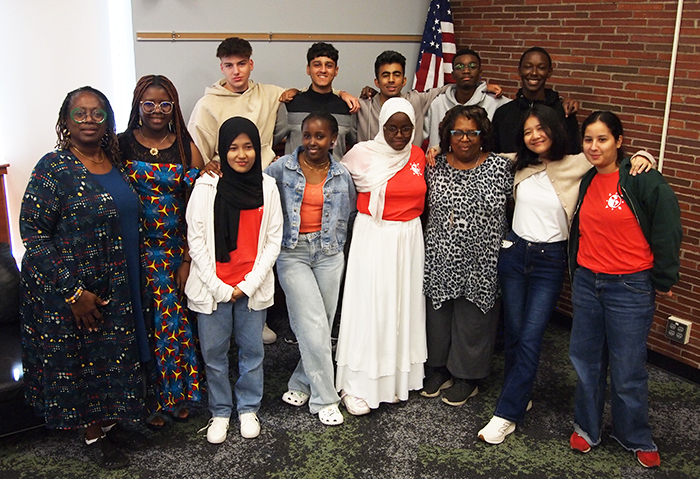
For 16 years, she has worked with American Cultural Exchange Service, or ACES, helping international high school students come to northwest Ohio. ACES works with the U.S. Department of State on international exchange programs, including the Kennedy-Lugar Youth Exchange and Study program, known as YES, and the Future Leaders Exchange program, or FLEX. ACES / Explore the World
Ellis has traveled to about 25 countries through her work.
But some of the most meaningful journeys belong to teenagers who arrive in Toledo having never traveled beyond their own communities.
Some have never seen a movie theater or shopping mall. Some come from communities without reliable running water.
For them, America can be startling.
For American students, the exchange can be just as powerful.
The world suddenly sits beside them in a classroom.
A Global Education Without a Passport
“We live in a global society,” Ellis emphasizes. “Our economies and our businesses, health, education, you can go on, are all globalized.”
As ACES Regional Director and Local International Coordinator, Ellis believes the program offers far more than a year abroad.
That is why she believes global education cannot be treated as an extra.
“We can’t raise globally incompetent kids.”
ACES students attend area high schools while participating in cultural activities, educational programs and community service. Ellis said many complete about 100 hours of service during the school year.
They also become teachers themselves.
They share food, traditions and stories from home. They introduce American students to countries many may never visit.
Ellis remembers a Sylvania Southview student whose family had hosted an exchange student. The experience inspired the young woman to apply for an outbound program. She spent six weeks in South Korea and now attends the Ohio State University doing global work.
That is the exchange Ellis wants people to see.
It is not simply about bringing foreign students to America.
It is about what happens to everyone around them.
“The beauty of the program is that the State Department offers the grants,” Ellis explains, “so that means we can bring students here from developing countries, even from places of conflict.”
Then the Numbers Changed
Today, Ellis says the program looks very different.
“This is my 16th year,” she says. “We’ve been through a couple different administrations from when I first started, and it’s very, very different this time.”
She says the local number of students has been cut roughly in half.
“This is the first year in my 16 years with the program that I’ve had no students from Africa, no students from the Middle East, no Palestinian students,” Ellis shares.
That is her first-hand account.
The federal record helps explain why the distinction matters.
The State Department describes YES as a merit-based scholarship program for students from countries with significant Muslim populations. Created in 2003, the program was designed to promote mutual understanding between Americans and people in participating countries. U.S. Department of State: Kennedy-Lugar YES Program
FLEX has a different geographic focus. The State Department describes it as a merit-based exchange program for students from Europe and Eurasia. U.S. Department of State: FLEX Program
That contrast is at the center of the local concern.
The question is not simply whether exchange funding has changed.
It is which programs changed, by how much, why and with what effect on students.
Following the Federal Dollars
Ellis says the Trump administration cut $100 million from the State Department budget affecting the program.
Federal budget documents show substantial proposed reductions to State Department international exchange funding. NAFSA reported that the administration’s FY2026 budget proposal sought a 93 percent, or $691 million, reduction in State Department exchange-program funding. NAFSA: FY2026 Funding for International Education and Exchange Programs
But there is another piece of the record.
The federal government also issued a FY2026 funding opportunity for FLEX Global, with up to $35 million in anticipated funding and a goal of supporting exchange involving as many as 1,200 foreign students coming to the United States. FY2026 FLEX Global Federal Funding Opportunity
So the evidence does not show that the federal government simply ended international student exchange.
It shows a more complicated picture.
Some programs have faced reductions while others continue to receive federal support.
Whether those changes are driven primarily by budget priorities, foreign-policy strategy, administrative decisions or other factors is a question that deserves documentation from the federal government.
That distinction matters.
It keeps the reporting grounded in what can be verified while still examining what Toledo is experiencing.
Another Barrier: Getting Here
Funding is not the only change.
In May 2025, the Trump administration temporarily paused scheduling new student and exchange visitor visa appointments while the State Department prepared expanded social-media screening. Appointments later resumed with additional vetting. Reuters: Student and Exchange Visitor Visa Appointment Pause
A separate DHS rule scheduled for September 2026 would establish maximum periods for certain F, J and I visa holders, with J exchange visitors generally facing a four-year maximum. The rule has faced legal challenges. Reuters: Challenge to New Visa Duration Rule
These policies do not, by themselves, explain ACES’ local numbers.
They do show why the environment surrounding international exchange is changing.
And Ellis is watching those changes from the ground.
The Families Who Open the Door
For Ellis, the statistics eventually lead back to people.
Host families volunteer to house students for an entire school year. They are not paid, although students receive stipends for personal expenses and the program provides support.
Some families host once.
Others keep doing it.
Ellis knows one family that hosted for 10 consecutive years. Her own sister hosted approximately 11 students while raising her sons.
“This is not one-sided,” Ellis believes. “This is something that happens for both Americans and international students.”
That is one reason Ellis wants to increase participation among Black families.
She spent roughly a decade as the only African American person in her organization nationally, she points out. Tracee also believes communities of color should have more exposure to international exchange, both as hosts and participants.
Additionally, her work has expanded beyond traditional exchanges to include virtual international visits.
Through virtual tours led by former exchange students, Toledo families and students can visit homes, neighborhoods and communities in countries such as Egypt and Mozambique, seeing the world through the cross-cultural eyes of someone sitting beside them in a local classroom.
A passport is not always necessary to begin seeing the world differently.
Sometimes, the world comes to your classroom.
One Student Is Still Waiting
When Ellis and I spoke, eight international students were already in Toledo.
One young woman was still waiting for a host family.
Ellis says students can spend six to eight months completing the application and acceptance process. Under the previous system, an accepted student without a host family could sometimes be deferred to the following year.
That option is now gone, she explains.
“She’s the only one left,” Ellis says. “I’m really hoping that a family comes forward to host this young lady and give her the opportunity.”
That sentence puts a human face on a policy debate.
There is a young person who has already done the work.
She applied.
She qualified.
She waited.
Now the final piece is a family willing to open its door.
Ellis believes what happens next matters far beyond one student.
“These young people are going to have to compete globally in their careers,” she adds. “So we have to work harder at exposing our children to the world.”
The federal changes deserve scrutiny. Funding should be followed. Program numbers should be compared. Official explanations should be measured against what communities are experiencing.
But the reason Tracee Ellis keeps doing this work is not complicated.
“Just to try it, to be a part of it in some way or another,” she says, “really enhances, not just your learning, but your life.”
A teenager crosses a border expecting to learn about America.
A family opens its door.
A classroom gets a little bigger.
And suddenly, the world is not somewhere far away.
It is sitting right here in Toledo.
Interested in learning more about student exchange opportunities? Explore ACES, the American Cultural Exchange Service, and FLEX, the U.S. Department of State’s Future Leaders Exchange program, to discover opportunities for students, families and communities to connect across cultures.