

By Fletcher Word
The Truth Editor
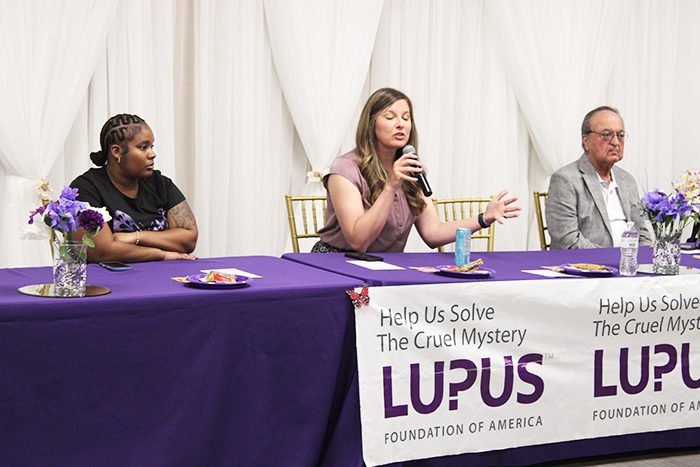
About 80 people came out for the fourth annual Lupus Awareness Luncheon on Saturday, May 16. The Scott Park Banquet Hall was filled to capacity with people who are living with lupus, family members of those diagnosed with lupus and community supporters of this cause. The Lupus Awareness Program was organized by two sisters, Felicia Howard and Victoria White, in honor of their sister Reeshemah Adams, who passed in 2018 of the disease.
Adams, who was born in 1978, was misdiagnosed at age 18, received the correct diagnosis at age 30 and passed at age 40.
Purple and white decorations welcomed guests as they wore purple ribbons, which is worn in promotion of lupus awareness. May is Lupus Awareness Month, according to the sisters and the Lupus Foundation of America. The awareness goal is to rally the community to raise funds for the cause, awareness about the symptoms and awareness for those who live or died from lupus.
Lupus is a chronic, also known as a long-term, disease that causes inflammation and pain in many parts of the body. Lupus is an autoimmune disease that causes the body to attack healthy tissue instead of fighting infections. As always, the reason for the luncheon was for those attendees to gain knowledge about the disease and the best ways of coping.
In order to raise awareness, the luncheon included panelists who spoke about mental and physical health, dietary needs and restrictions, and dermatology.

A panel of six experts fielded questions from the audience. The panelists were Bashar Kahaleh, MD, and Samantha Davis, MD, from the University of Toledo Medical Center, Rheumatology Department; Nicole Bergman, PA, from Mitchell Dermatology; Nailah Carpenter, MSW, LSW, Mental Health; Ryan Howard, Sr, certified fitness coach; Victoria White, author, The Three Day Parasite, Test and Eat to Elevate.
Lupus is a disease that disproportionately affects women (only 10 percent of those afflicted are men) and primarily those in the Black and Brown populations.
Why does lupus occur for some people? Do they have perhaps a genetic predisposition? That’s not entirely clear, however Dr. Davis did suggest that certain families might have a genetic predisposition to autoimmune diseases in general.
“It’s not automatically inevitable that you would get an autoimmune disease if it’s in your family, it’s just that you have an elevated risk of that,” said Dr. Davis.
Unfortunately, lupus is not always easily diagnosed and there is no cure, just various treatments to ease the pain at the moment. And, because of the traditional distrust within the Black community for the medical establishment, the way forward is complicated, said Dr. Kahaleh. He spoke of the lack of participation in clinical trials by the Black community because of that lack of trust and that lack of trust is unfortunate because Black lupus patients are generally his harder by the disease than Caucasians.
 While treatments are varied, for certain symptoms such as joint pain, physical therapy can be effective, said Howard, the certified fitness coach. Howard has worked with a number of lupus patients over the years and has been able to alleviate the pain the lupus can cause in the joints, he noted. Exercise, he said, is very important – “get your body moving.”
For skin issues, steroid cream may help in the short term but long-term use may do damage to the skin., said Bergman of Mitchell Dermatology. However, non-steroid creams have been developed that can be used long-term. She also spoke of the necessity of using sun screen and protective clothing since lupus patients can be adversely affected by ultraviolet rays even when it’s cold or cloudy.
Mental health, healthy eating habits, the variety of lupus symptoms were all pints of discussion for the engaged audience and the knowledgeable panel.
In addition to the panel discussion, lunch was provided by Big Back Kitchen and a door prize raffle was held
For additional information about lupus, visit the Lupus Foundation of America Greater Ohio chapter website or the Lupus Foundation of America national website https://lupusgreaterohio.org/ or https://www.lupus.org/