
Toledo’s proposed Monroe-Oregon corridor could bring faster, more frequent service, better connections and new economic opportunities to the region.
By Asia Nail
The Truth Reporter
For someone who depends on public transportation, a bus arriving 15 minutes late isn’t just an inconvenience. It could mean missing a shift, arriving late to a doctor’s appointment or spending another hour trying to get home.
Time matters. And for Toledo residents who depend on the bus to keep life moving, the future of public transportation could be looking a little brighter.
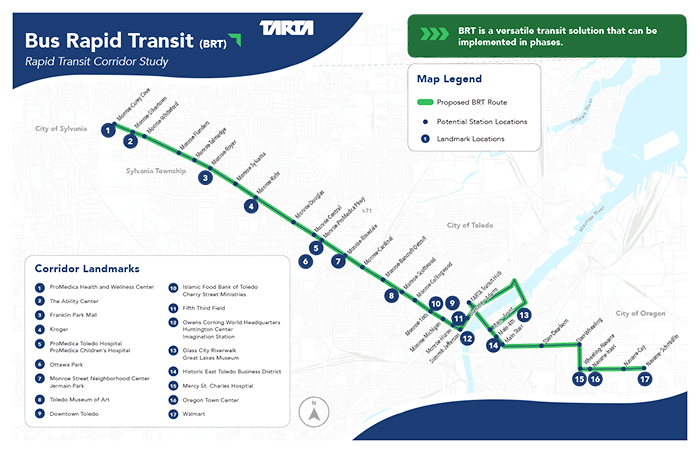
The Toledo Area Regional Transit Authority (TARTA) is moving forward with plans for Bus Rapid Transit (BRT), a high-frequency transportation system designed to make getting around the city faster, more reliable and more convenient.
Deputy CEO Rick Bailey says one of the biggest differences riders will notice is how often the buses arrive.
“Typically it runs every 15 to 20 minutes,” Bailey explains. “So you’re really not having to worry about a schedule because you know the bus is going to come 15 minutes later.”
That kind of consistency could make a meaningful difference for people whose days are already carefully scheduled around work, family and other responsibilities.
More Than Just Another Bus Route
Unlike conventional bus service, BRT combines elements of traditional buses with features commonly associated with rail systems. The proposed improvements include enhanced stations, level boarding platforms, off-board payment options, security cameras, better lighting and signs displaying real-time arrival information.
Some BRT systems also use dedicated bus lanes, allowing vehicles to bypass regular traffic. Fewer stops along the route can help reduce travel time, too.
The idea is simple: Spend less time waiting and more time getting where you need to go.
The project began taking shape in 2021, when TARTA conducted a comprehensive operational analysis to evaluate existing service and identify opportunities for improvement. Five local corridors were initially identified as potential candidates for high-frequency service.
In 2024, TARTA applied for an Ohio Department of Transportation grant to fund a planning study. Four corridors were ultimately evaluated, with the Monroe-Oregon corridor scoring highest.
Public input was also part of the process, helping inform the direction of the proposed project.
Connecting People to Opportunity
Transportation is often the invisible thread connecting people to opportunity. Without reliable transportation, even a good job or an important medical appointment can feel frustratingly out of reach.
Bailey believes BRT could improve access for residents living along the corridor and those connecting from other parts of TARTA’s service area.
Several existing mainline routes already intersect Monroe Street, providing opportunities to connect riders with the new service.
The proposed operating hours would run from approximately 5 a.m. until midnight, extending service beyond current operating hours.
Bailey also points to the corridor’s economic significance. Approximately 20 percent of Lucas County’s jobs are located within the corridor, making it an important area for both transportation and future development.
And the benefits may reach beyond the bus stop.
“If you can get a comparable trip time for people, it makes the decision to go car-free or down to a single-car household a lot easier,” Bailey says.
For a family juggling rising expenses, reducing the need for a second vehicle could mean more money available for groceries, housing or simply catching up on bills.
An Investment in Toledo’s Future
BRT could also serve as an economic development tool, encouraging businesses and investment along the route.
Bailey refers to Cleveland’s HealthLine as an example of what can happen when transportation improvements become part of a larger development strategy. Since its launch in 2008, the corridor has attracted nearly $9 billion in investment, according to Bailey.
While he cautions against assuming Toledo will see the same level of investment, he notes that the industry generally points to a potential three-to-one return on investment.
Still, getting there will take patience.
Bailey estimates that projects of this scale often take seven to 10 years from completion of the locally preferred alternative (LPA) planning process to construction. The work involves extensive community outreach, planning and design, with coordination among the city, other jurisdictions and emergency service providers.
Realistically, he anticipates a potential launch in 2032 or 2033.
Dedicated lanes and traffic signal priority will also require careful consideration. Bailey emphasizes that signal priority is not a required feature of every BRT system and that its use will, for the most part, depend on regional decisions and the needs of motorists, pedestrians, cyclists and emergency responders.
Moving Toledo Forward
When Bailey imagines Toledo a decade from now, success means more than having a new transportation line on the map.
“I think 10 years from now, the line will expand regional connectivity and improve mobility for not only people who live along the corridor but also for people in our general service area,” he adds.
That is an important distinction. A successful transportation system shouldn’t simply move buses. It should open doors for the people who depend on them.
For Toledo, BRT is ultimately about making everyday life a little more accessible. It’s about a worker having a dependable ride before the sun comes up, a senior reaching an appointment with less worry and a family having more choices about how it gets from one place to another.
Beyond the pavement and bus stations, the project represents an opportunity to strengthen Toledo’s economic growth and quality of life. A more connected city is one where people can spend less time worrying about how they’ll get somewhere and more time focusing on what awaits them when they arrive.
Toledo’s journey toward that future won’t happen overnight. But with thoughtful planning and community investment, the next generation of riders could inherit a city that’s easier to navigate and a lot more connected.
For more information about Toledo’s proposed Bus Rapid Transit project, including planning updates, project details and opportunities for community involvement, visit TARTA’s website here