 By Jefferson Díaz
The Truth Reporter
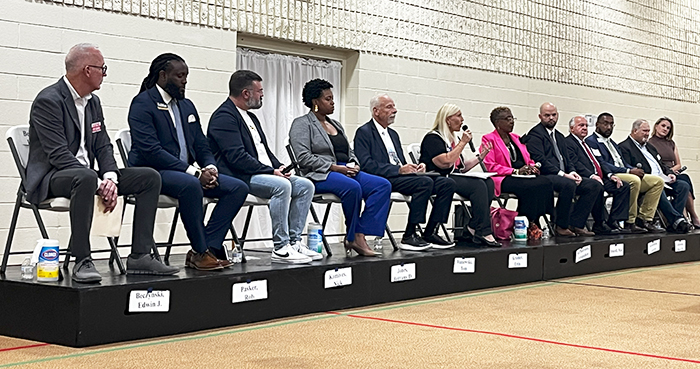
Toledoans gathered last, September 18, at the Indiana Avenue Missionary Baptist Church to hear from all 12 candidates running for the six at-large City Council seats in the November general election. The forum offered a chance for voters to compare incumbents with challengers in a single, organized setting.
The event was hosted by a coalition of several neighborhood organizations such as the Junction Coalition, NAACP Toledo and The Movement. The debate covered a broad spectrum of city issues such as public safety, the budget, housing, homelessness and community engagement.
Incumbents Carrie Hartman, George Sarantou, Mac Driscoll, Cerssandra McPherson, Brittany Jones and Nick Komives were joined by former councilman Tom Waniewski, retired engineer Tom Names, small business owner Blair Johnson, real estate broker Robert Pasker III, higher education admissions director Erin Kramer and restaurateur Ed Beczynski.
 Let’s talk about budget
Council President Carrie Hartman, a Democrat, emphasized the council’s role in responsibly allocating funds from the American Rescue Plan Act (ARPA).
“We’ve been required to appropriate all those dollars, so that’s why our budget is getting a little tighter this year because we’ve spent the ARPA dollars, and we invested them in the way that we were supposed to,” Hartman said.
Independent candidate Ed Beczynski went with a different approach, highlighting the need for economic growth rather than cuts. “The one thing I heard from everybody is cut, cut, cut. How about growth?” Beczynski said. “How about bringing more tax money into the city? Because we know where the money is going. Are we going to cut police and fire? No. Let’s grow the city, make it clean and safe, where people will come to Toledo and bring more jobs.”
Talking about the city’s budget, the housing problem was also a central focus with the candidates offering solutions to the city’s housing challenges.
Real estate broker Robert Pasker III argued that increasing housing inventory and renovating existing properties were key.
“For me, it’s about how we can create more inventory first and foremost,” Pasker said. “The demolition list is about 300 properties right now. It’s cheaper to renovate than to demolish.”
Blair Johnson, a candidate with experience in construction, emphasized funding opportunities to rehabilitate homes already in the city’s inventory.
“One of the biggest things I see is we tear down a lot of houses,” Johnson said. “There are a lot of houses that are structurally unsafe, but we also have a lot of houses that can be saved. The foundation of these houses, they may need to be torn down on the inside and put back together, but that gives us a baseline and foundation to be able to get people in homes.”
Retired engineer Tom Names connected housing to broader economic opportunity.
“My number one priority is supporting the American dream,” Names said. “You do that through home ownership. I’d like to see more people engaged with owning properties, and I want to see diverse ownership.”
Erin Kramer, who works in higher education, stressed the importance of resources for unhoused residents to achieve self-sufficiency.
“I’m worried about the cuts from the federal government and how that will impact the services we have here in Toledo,” Kramer said. “I work very closely through my job at Owens Community College with the Cherry Street Mission in order to make sure that folks are able to get certificates and training, so they can go get a job and have a sustaining wage.”
Working with communities of color
Questions on representation and accountability prompted several candidates to outline ongoing efforts to engage with communities of color.
Mac Driscoll highlighted his work through the Toledo Design Center. “We do a lot of community engagement in the neighborhoods surrounding downtown,” Driscoll said. “We talk to folks who are involved in neighborhood organizations like Junction, Vistula, East Toledo.”
Brittany Jones emphasized her efforts to meet constituents through town halls. “I’ve hosted town halls,” Jones said. “I’ve had two per district to make sure that I cover all of the areas and hear all of the concerns, and I want to continue that.”
On this topic, working with youths and seniors was also a focus point, on that matter Cerssandra McPherson highlighted the importance of reaching both youth and seniors who may not otherwise engage with city government.
“We need to reach out to the seniors who are unable to go to different meetings,” McPherson said. “We need to go and have a conversation with them to ask them, ‘What is the need? How can we help you?’ And with our young people, we need to continue to listen to them, and provide opportunities where they can come and speak and be free.”
Nick Komives underscored creating opportunities for youth development beyond after-school programs.
“It’s also about creating the opportunities for them to think about what their future looks like,” Komives said. “I would point specifically to our Re-Tree grant, where we built into that grant the opportunity for youth to learn tree-trimming and other important jobs.”
More safety
Safety and policing were also central issues. Former councilman Tom Waniewski focused on bringing back Block Watch programs to strengthen neighborhood relations with police.
“If you’ve been to a Block Watch meeting, the community officer will tell you all the crimes that have been committed. I want them to come back because it will improve the public relations and the community relations in the neighborhood,” Waniewski said. “Police are our friends. They should be. It takes a big chunk of the budget, so we have to support that.”
Independent incumbent George Sarantou highlighted the importance of a broader approach to public safety, including domestic violence prevention.
“When I returned to city council four years ago, I was a very, very strong advocate, and I am still a strong advocate, for the city’s administration and council working closely with the courts, the juvenile courts, the municipal courts, the common pleas courts because those judges and magistrates see it all every day,” Sarantou said.
The forum concluded with brief closing statements from each candidate. Residents stayed after discussing policy proposals, evaluating candidates’ vision, and considering how each might influence Toledo’s future. Voter registration for the election closes October 6, with early in-person voting beginning October 7. Election Day is November 4.