
By Fletcher Word
The Truth Editor
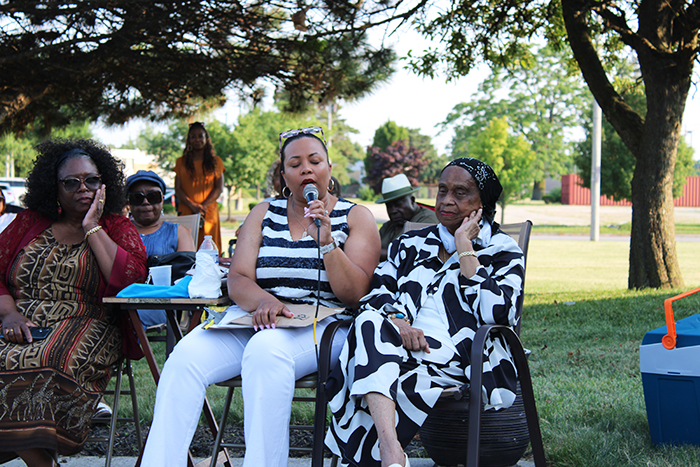
The African American Legacy Project held its monthly First Tuesday on July 7. The theme of that week’s patio series was “Bridging the Generations” and Jamilah Jones Martin, PhD, dean of Arts and Sciences at Northwest State Community College, was invited to explain her thoughts on the subject in light of the fact that her family and her mentors in her educational endeavors have been so effective at exactly that – bridging the generations.
“If you scratch beneath the surface of most modern social movements, you will find a black woman; we are rarely celebrated in textbooks, we have to appoint ourselves into authority,” said Jones Martin as she pointed to the effectiveness that generations of Black women have had in the face of adversity.
“I was birthed in legacy,” Jones Martin said opening her remarks to the audience of about 50 who had gathered for the First Tuesday event.
She was not only birthed in legacy, a legacy that her elders – mother, grandmother and great grandmother – took care to instill, but she was also educated in legacy by mentors such as Helen Cooks, PhD, the founder and former long-time leader of the University of Toledo’s Excel Program when Jones Martin entered the fifth class.
Cooks, in fact, was on hand last Tuesday to introduce Jones Martin to the attendees.
“I knew she was a leader,” said Cooks of her protégé. “That she was somebody that is going somewhere. She is a leader who’s committed to education, to service and to the community.”
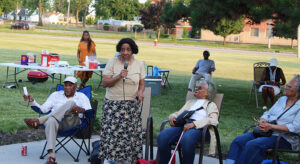 Birthed, reared, educated and mentored by Black women, Jones Martin certainly had her thoughts about why and how those and other numerous Black women have been so successful.
“Black women are subversive,” she said. “A Black woman finds a space. That very subversiveness is something that has always carried the African American culture through. I have been raised and cultivated by Black women and that led me to try and understand Black women’s every move. Black women have a superpower that is very critical now.”
Jones Martin explained that superpower as the ability to get people to the table and building bridges – a superpower that has evolved because of the intersection of blackness and womanhood – “the oppression of being Black and a woman at the same time.”
That ability to build bridges enables Black women “to build trust in our community – we carry what we learn in our homes, our churches and into our workplaces.”
Jones Martin’s family ties to that ability to build bridges goes back generations. Her great grandmother, who was one of the first presidents of the Toledo NAACP, was also a Henrietta. The Henriettas, still active, were founded in 1881. “A mutual aid and mutual benefit society,” as noted in writings about their mission.
It was a group of women who decided that they needed to meet, to talk, to check on neighbors, to encourage each other. Their constitution, which was written down again in 1951 speaks of the need to organize for “literacy, social and moral uplifting.”
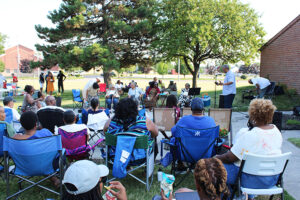 Now, said Jones Martin, in order to preserve what generations of Black women have accomplished, this current generation of leaders needs to preserve that legacy and those stories. The current generation needs to connect youth to those stories, especially since established educational and media institutions “are afraid to talk about us anymore.”
Putting that subversive Black women leadership to the best use is by instilling a sense of community to those who are to follow, she added.
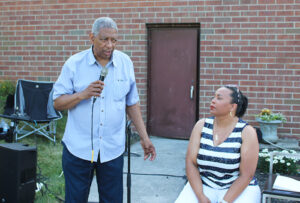
As always, Robert Smith, founder and director of the African American Legacy Project, lead the discussion – introducing the speaker, following up her address with questions and fielding questions himself about what is happening in the city to preserve the legacy that Jones Martin discussed. Smith enlightened to attendees about the work that the AALP is doing to restore the community that once thrived along Dorr Street.
The next First Tuesday will be August 4.